
How Your Digital Footprint Puts You at Risk of Social Engineering Attacks

Most high-value individuals assume their biggest risk is being hacked. Usually it isn't. It's the information already published about them, sitting there for anyone prepared to look.
A digital footprint builds up in fragments. A filing here, a photograph there, an old account somewhere else. None of it looks like much on its own, but put together it describes a life in enough detail to act on. For the people who target high-value individuals, that assembly work is where an attack starts.
A lot of people assume that staying off social media keeps them safe. It helps, but your footprint is likely far wider than you'd expect, and most of it comes from sources other than your own accounts.
The tools have changed too. Open source intelligence, or OSINT, techniques are increasingly supported by AI, which lets attackers collect and connect information much faster than before. The threat this poses to personal privacy is practical, and it is growing.
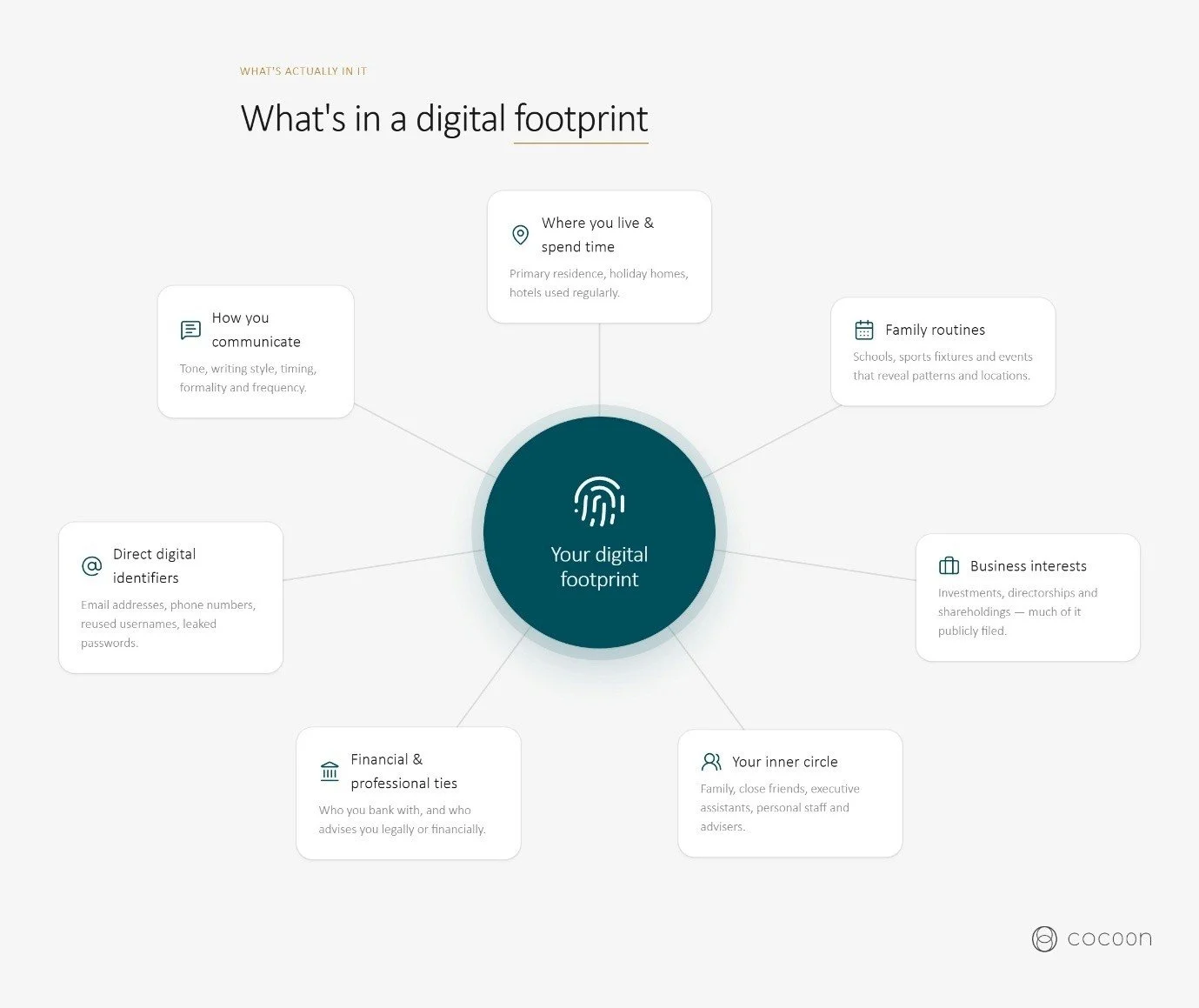
What's in a typical digital footprint?
For most high-value individuals, a digital footprint includes far more than people realise:
Where you live and spend time: your primary residence, holiday homes, hotels you use regularly.
Family routines: where your children go to school, sports fixtures, events that reveal patterns and locations.
Business interests: investments, directorships, shareholdings and partnerships, much of which is publicly filed and searchable.
Your inner circle: family, close friends, executive assistants, personal staff, advisers.
Financial and professional relationships: who you bank with, who advises you legally or financially.
Direct digital identifiers: email addresses, phone numbers, reused usernames, and sometimes compromised passwords.
How you communicate: tone, writing style, timing, formality, frequency.
None of it is dangerous by itself. Pulled together, it gives an attacker enough to build something convincing.
How it gets used against you
Two things tend to happen once an attacker has this information. The first is digital. If they know who you bank with, understand your investment activity and have your email address, they can write a message that looks entirely legitimate. It might ask you to approve a transaction, review a document or open an attachment, and from there it's a short step to malware or a compromised device.
The second happens offline. If an attacker knows the gym you use, the clubs you belong to or the classes you attend, they can put themselves in those places deliberately. A chance encounter turns into familiarity, and familiarity into trust. Once the relationship feels normal it can be used to gather more information, request introductions, or set up something later that arrives from a real person you know rather than an anonymous email.
A real world example
One of our UK clients banked with a well-regarded private bank. He had sold a property ahead of buying another, which left a significant sum sitting temporarily in one account. When he came to make a six-figure transfer, it was refused. The account was empty.
The attackers had profiled him carefully. He had no social media presence himself, but his children posted regularly from the family's country estate, and that was enough to mark him out as a target. From there they gained access to his email, learned who he banked with and found a pending property transaction. Going through his sent messages, they found a document with his signature and bank details, along with information about his spouse and other personal identifiers.
They used that to apply to the bank to be added as authorised signatories on his account. When the sale completed and the funds landed, they moved quickly, removing six-figure sums before the fraud was caught.
We've seen variations on this. In other cases, email compromise gave attackers access to sensitive personal material, and the leverage was the threat of exposure rather than the money in the account.
What you can do about it
There are three practical steps worth taking, whether you handle them yourself or with support.
Identify your digital footprint. Understand what information about you and your family exists online, where it came from and how it could be used. Most people find this eye-opening, including those who consider themselves careful.
Remediate what you can. Close accounts you no longer use, minimise publicly visible personal details, remove private information where possible, and keep the accounts you use for communication separate from those used for registrations and services.
Monitor for exposure. Not every leak is your doing. Breaches at law firms, airlines, utility providers and other organisations you trust regularly expose personal data. Monitoring means you can act before the information is exploited.
Much of this can be done independently. It's time-consuming and administratively heavy, but it addresses one of the most significant areas of personal cyber risk. Others prefer to work with specialists, largely because staying on top of it takes sustained attention.
The underlying point is straightforward. The more visible your life is, the more context an attacker has to work with, and reducing that visibility is one of the most effective protections available to you.