
Private Residence Cyber Security: How 'Smart' Is Your Home?
Prime properties have always drawn attention. Previously that attention came from burglars and physical intruders, and the response was walls, gates, alarms and cameras. Today there is a second kind of attention, quieter and easier to miss: digital intrusion into the home itself.
For high-value individuals and their families, a modern home is far more than a place to live. It is a connected environment, designed for comfort, convenience and security. That sophistication is a wonderful thing but it also brings complexity, and complexity is where risk tends to hide.
What makes a home vulnerable?
Step through a private residence today and you will find technology in almost every room. Alarm systems, CCTV and secure entry are the visible layer. Behind them sits a high-performance Wi-Fi network, home automation, multi-room audio, gaming consoles and a steadily growing collection of connected devices. Gym equipment, wine fridges, robotic lawnmowers, pool sensors: the list is longer than most people imagine.
Individually, each of these feels harmless. Most fade into the background of daily life and are never given a second thought. From a security point of view, though, every connected device is a possible way in.
Attackers rarely go straight for the obvious target. They look for the weakest link, which is usually a device that feels peripheral or unimportant. Once that device is compromised, it can become a quiet foothold, a place from which to move across the rest of the home network unnoticed.
How these attacks actually happen
In practice, most home compromises follow a familiar path. It tends to begin with an everyday connected device: a thermostat, a camera, a smart appliance. These are the things most easily overlooked when people think about security.
Sometimes the cause is simple. A default password was never changed. In other cases the weakness sits outside the home entirely. A service the device relies on is breached, or a flaw in the device itself is exploited. When that happens, the compromise arrives through completely normal use, with nothing for the homeowner to have done differently.
Once a device has been reached, it can be put to work in two main ways. The first is information gathering, quietly capturing data through its ordinary function and sending it elsewhere. The second is lateral movement, using the device as a bridge to reach more valuable systems on the same network.
From there, a clearer picture starts to form. An attacker can learn routines, habits and the shape of a household's digital life. Over time, that interest can extend to phones, laptops, personal accounts and, in some cases, work systems connected to the same network.
The scale of it
One of the most striking things about a modern home is simply how many connected devices it holds. It is not unusual for a large residence to run into the hundreds, added gradually over years. Alarm providers, CCTV installers, automation specialists and everyday purchases each add their own pieces.
What is almost always missing is a single view of how all of it fits together. Each provider looks after their own corner. The alarm company is not responsible for the security of your smart appliances. The supplier of your connected gym equipment is not thinking about how it sits alongside your cameras. The outcome is a layered environment full of hidden connections, and those connections are where the risk quietly gathers.
What we have seen
These risks are not theoretical. They are already being used.
We have seen smart appliances compromised in ways that exposed account credentials. We have seen cameras and monitors reached remotely, and connected devices pulled into wider networks controlled by others.
During one Private Residence Review, we found a central automation system running everything from music and climate to televisions and CCTV. It had been left significantly out of date, with well-documented weaknesses that were publicly known. Had those weaknesses been used, someone could have gained a view into the home itself, into spaces where privacy was simply assumed.
In another review, the cameras were reachable directly from the internet. The wider network was well looked after, but that one setting was enough to leave a door open to the outside. Once we identified it, the fix was straightforward: remove public access and limit visibility to trusted users only.
The theme running through all of these is consistent. Risk rarely comes from one dramatic failure. It comes from overlooked connections and quiet assumptions.
Why a smart home is hard to secure
The underlying challenge is structural rather than technical. Most homes grow over time. Technology is added in phases, often by different providers, each with their own standards and priorities. Devices are chosen for how they perform, how they look and how convenient they are, and security is rarely the deciding factor.
The result is a home made up of many interconnected systems with no single strategy holding them together. This is what makes residential security different from anything else. It is no longer about protecting one device at a time. It is about protecting the whole as a single, connected environment.
How to strengthen your home security
The reassuring part is that meaningful improvement does not require tearing everything out and starting again. A few practical steps make a real difference.
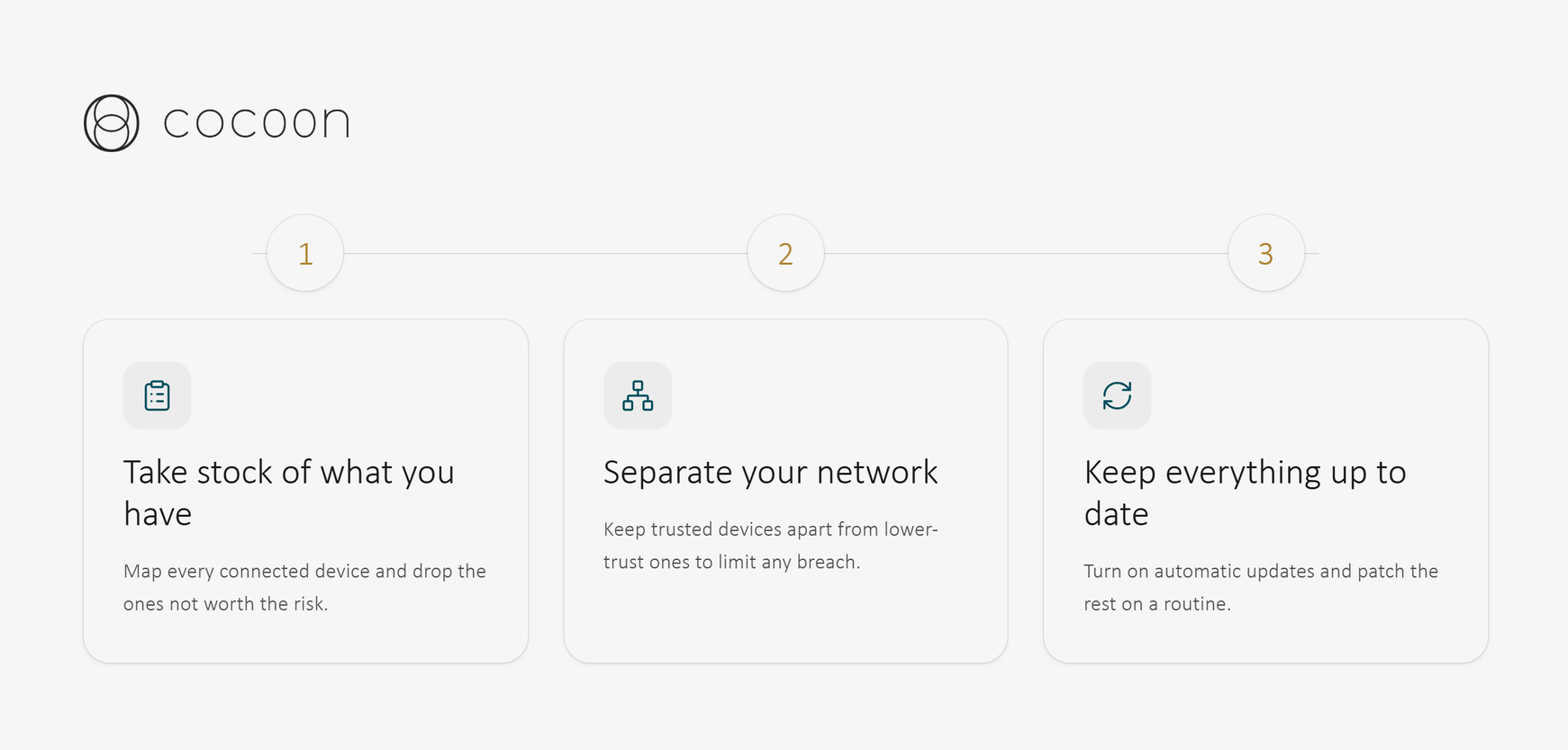
Take stock of what you have. Start by identifying every device in the home that connects to the network and consider what each one can see or generate. Some devices, on reflection, simply are not worth the risk they carry. It is also worth thinking about the brands you rely on. Lower-cost devices may do the job, but security is often the first thing sacrificed to reach the price.
Separate your network. Not everything needs the same level of access. Keep the devices that matter most, such as your phone, laptop and work systems, separate from lower-trust connected devices. Where a device does not need internet access at all, remove it. These boundaries limit how far anyone can move if a single device is ever compromised.
Keep everything up to date. We expect vulnerabilities to be exploited more frequently as AI continues to evolve so make sure devices are patched and updated regularly. Many offer automatic updates, but this is not always switched on by default. It is worth reviewing the settings across your devices to confirm updates are active, and setting a simple routine to check the ones that need doing by hand.
The point to hold on to
A modern home offers remarkable convenience. It also widens the number of ways in, quietly and considerably. Recognising that is the first step.
Real home security comes from seeing your residence not as a set of separate devices, but as one connected system. Viewed that way, the risks become clearer and, more importantly, far easier to manage. With the right visibility and the right guidance, a home can stay every bit as sophisticated as you want it to be, and remain genuinely safe at the same time.
If you would like to understand where your own home stands, a Private Residence Review is a calm, thorough place to begin. Get in touch to find out more.